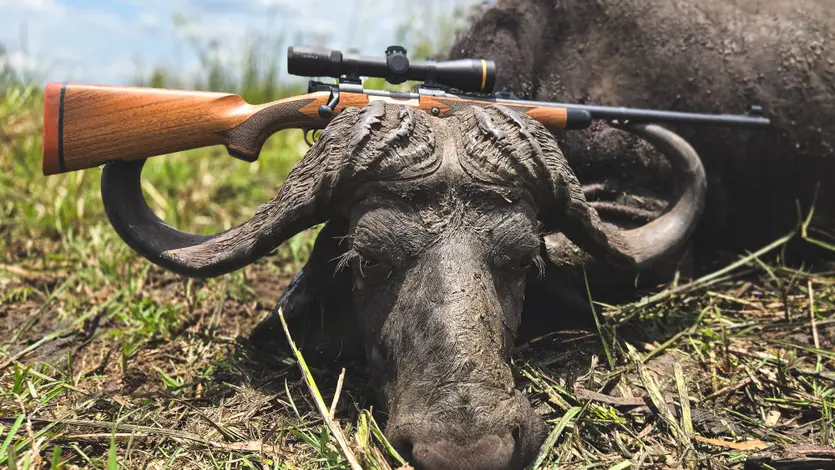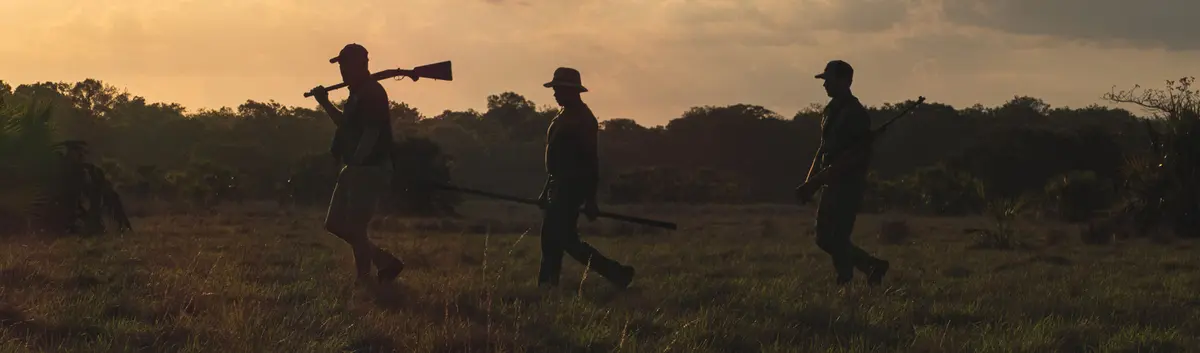
The Winchester Model 70 on the Dark Continent: On the Hunt for Cape Buffalo
Published September 30, 2026 by Rafe Nielsen
“Shoot the one with the big @#$% bosses!” I could hear my professional hunter (PH) yell in the heat of the moment. He probably didn’t actually yell it, but it was a stern whisper and I knew my assignment. A herd of nearly 200 Cape buffalo were scattering in chaos after my hunting partner had dropped a large bull out of the herd moments earlier. We scrambled from our hiding place in the sawgrass and stood in the open while buffalo fled around us. I scanned desperately looking for the targeted bull. “Big bosses, big bosses,” I kept telling myself.
There were a lot of bulls in the herd, but I could tell by the inflection of my PH’s voice that I’d know which one he was talking about. Out of the mass of black bodies one big bull finally stopped, spun his head, and looked at me. That was the one. Deep curl and tips that rolled back, but the most dominant feature was the big bosses. Heavy, hard crown with gnarly ridges and crevasses carved into the horns. I settled the crosshairs square on his shoulder, waited for a cow to clear, took a deep breath, and squeezed the trigger.
There was no moment where time stood still, or everything moved in slow motion. It was instant pandemonium. The hit bull spun fast and bolted for the middle of the herd. They raced across the high ground, splitting left and right and gathering back together. My PH was leaning on my shoulder now, mostly speaking to himself as he searched for the bull, his voice heavy in my ears. The herd milled anxiously, confused, curious. My bull was somewhere in the fray.
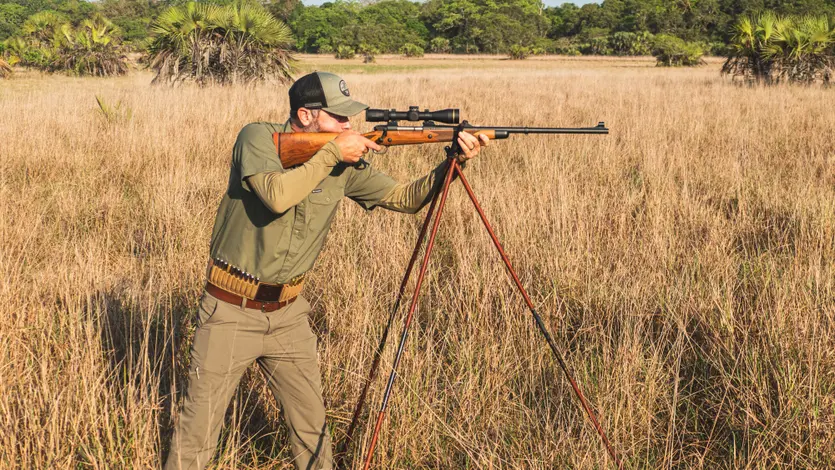
Suddenly I could feel the swirling wind hit our backs. My instincts kicked in and I immediately feared they would flee into the swamp, carrying my hit bull with them. But not Cape buffalo. Call it curiosity. Call it anger. It doesn’t matter. They lifted their collective noses and surprisingly came at us. Slow at first but quickened to a run. 200+ strong, a long line of advancing danger. I could hear the second PH behind us barking orders to his hunter and the trackers to reload and take cover the tall grass. We didn’t have that luxury. We were in the open with nowhere to go.
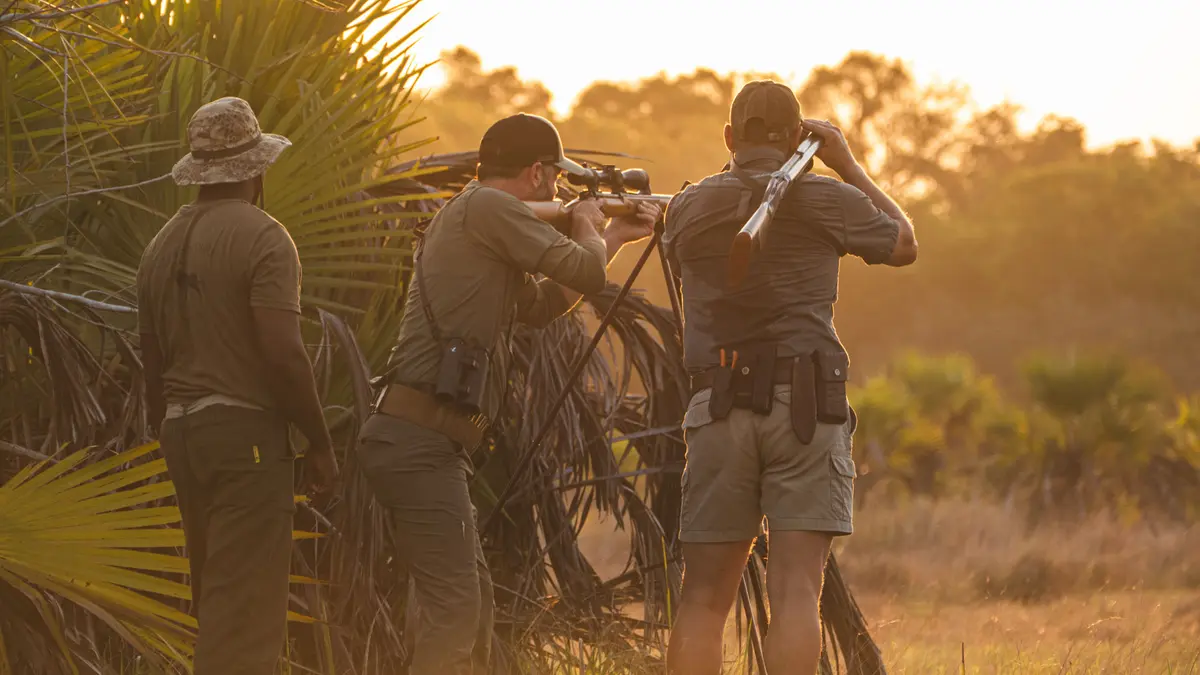
The only thing working to our advantage was the one large bull in the center of the herd that was bleeding from his nose. We knew which one to focus on. It was quite the sight, this herd of dark, black buffalo on the march, with a blood-soaked bull leading the charge. I could feel my PH jetting back and forth behind me, trying to create confusion and disperse the herd. It worked. After a brief sprint, coming from 200 to nearly 50 yards from us, the herd put on their brakes and scattered. Despite the swampy conditions, dust flew from their pounding hooves and filled the air. In the mayhem, my bull made one quick turn, separated from the herd, and gave me the opportunity to end it.
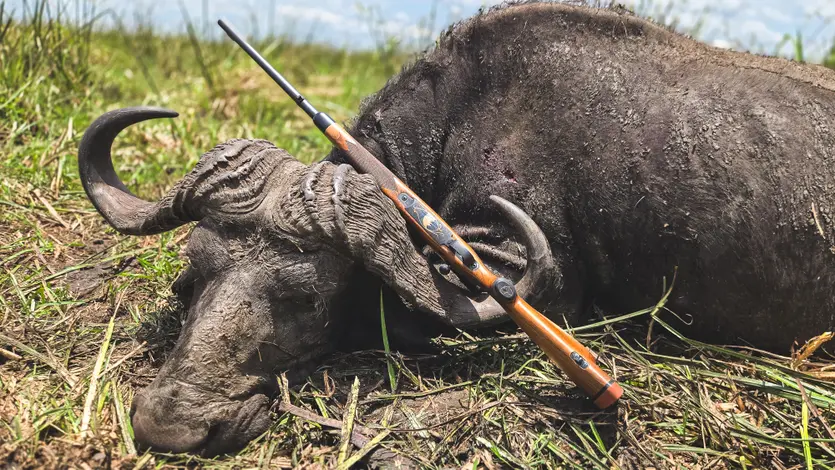
It was the longest and shortest experience of my life. In hindsight, we probably never were in much danger. The herd was more curious or confused than anything. My bull was hit well and didn’t have much fight left. But in that moment, I was alive. That’s why I made the excruciatingly long journey to the Mozambique plains. I had read the romanticized stories of Rourke, Hemingway, and particularly Walter Johnson, who hunted those exact same buffalo decades before. In no possible comparison to those legends, I did feel a commonality with the adventurers of old whose stories and words came to life in real time. Exaggerated or overdramatic as it may sound, that rush of adrenaline and dopamine was real, and the “why” we do this surged through my mind and the heartbeat I could feel in my still shaking knees.
I took a moment to reflect on how our day started and how we got here. It was dark when we loaded up the Land Rovers and headed across the flood plain. The rising sun backlit a savanna engulfed in an early morning fog. Acacia trees, herds of zebra, and a single lion track appeared in the gathering light. Soon the heat burned the fog away, leaving a crystal-clear view of the Zambeze River delta and its outlying swamps. Cape buffalo would be found in large vast herds feeding on the dried highlands and seeking solace from the 100-degree heat in the papyrus groves and muddied river channels choked by razor-sharp sawgrass. It’s not a welcoming environment.
We held to the high ground for as long as we could, but eventually we had to wade into the muddy waters, crossing through the remnants of the riverbed. Ankle deep at first, then knees, then to our waists. Ammo belts were striped and carried over our shoulders to keep them dry, and rifles held high to avoid splashing dirty water and mud on the actions and optics. Some channels were narrow and deep, while others were open bays covering acres of swampy waters. Despite the muck and the mess, the cool water was welcomed in the rising heat. What started as a mild morning had quickly advanced to high summer temperatures.
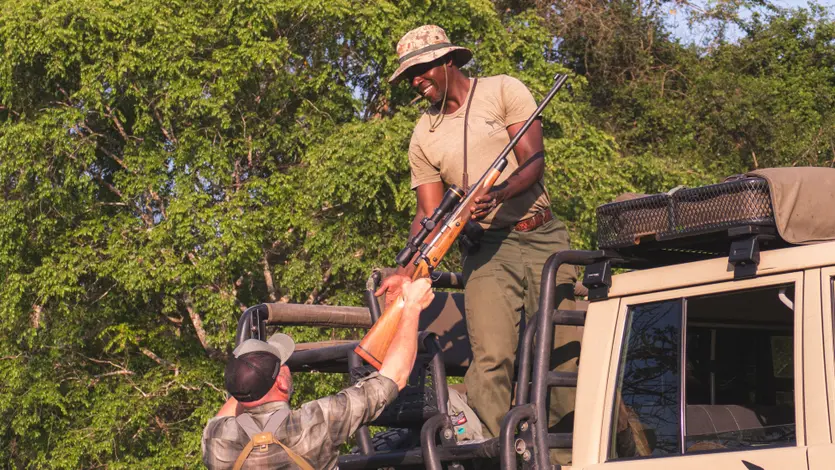
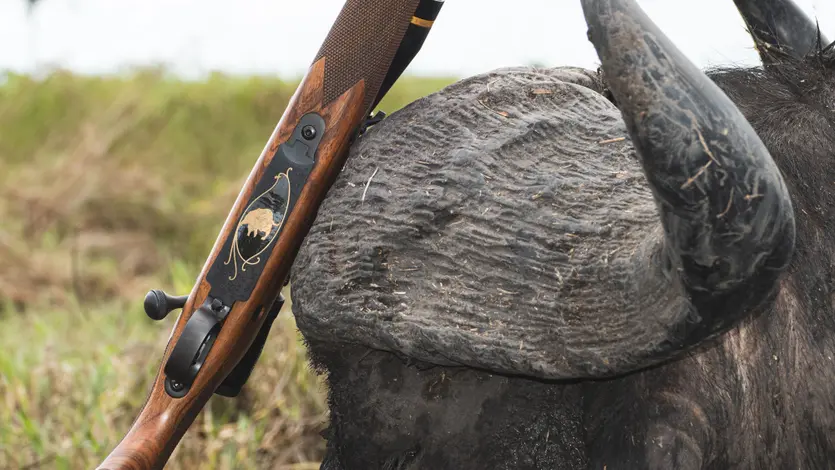
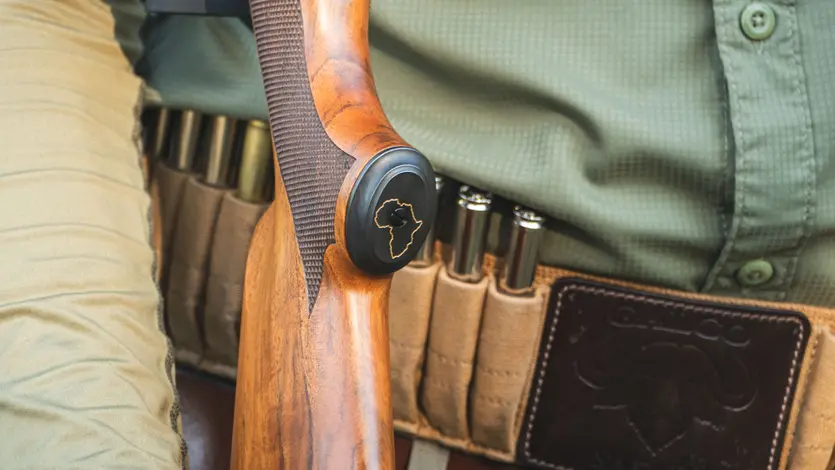
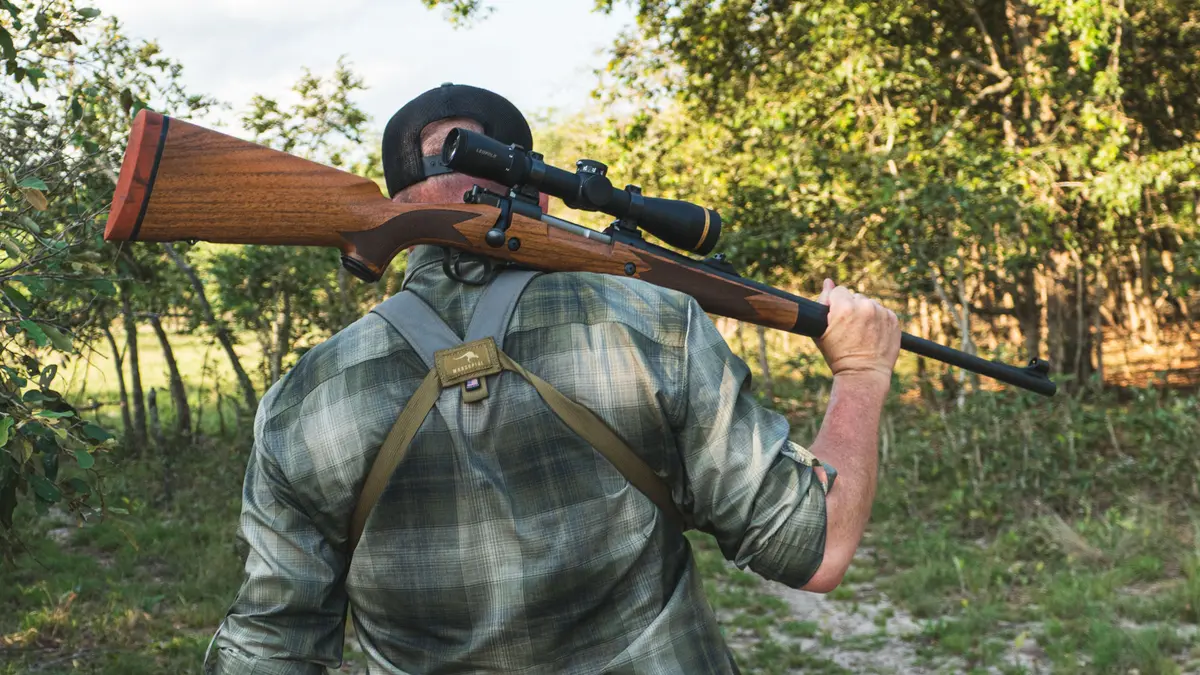
We scanned the horizon for white egrets, a tell-tale sign of nearby herds of buffalo. Once found, we circled around to catch the wind, crossed one more body of water and found ourselves crawling across the ground to catch a look at the bedded and feeding herd. While the PH’s scanned for old bulls, I looked down at the rifle I had in my hand. A Winchester Model 70 Safari Express Cape Buffalo Edition in .375 H&H. Not an old pre-’64 classic, but something special in its own right. It was a first-run sample of a new limited edition Safari Series. This series modifies the existing Safari Grade guns, with enhancements of a satin finished and finely figured Grade II French Walnut stock, a throwback traditional “red” recoil pad, a thinned-out barrel profile, and a unique Africa outline engraving on the grip cap. But most notably, this was the Cape Buffalo Edition, featuring a gold engraved floorplate depicting the death stare of a giant bull, not unlike what I was about to encounter in the upcoming moments.
The PH’s gave the head nod, and we knew it was go-time. Big bulls had been spotted and identified. I wrapped my hand around that Model 70, glanced one more time at that floorplate, and hoped to put it to work.
All hunts carry different memories. Pictures in a photo album, journal entries, or taxidermy hanging on the wall send us back in time to relive our greatest moments. But for me, every time I take out that Model 70, I’m thrust back to a place and time I wish I could forever return. There’s mud still caked in the checkering, and a few minor scratches and dings on the stock. But each mark means something to me and reminds me that for special moments we deserve fine guns to share them with. For me, it’s this new Winchester. A keepsake worthy of passing down to future generations.
Gear Used:
Winchester Model 70 Safari Express Cape Buffalo Edition
- One-piece bottom metal with engraved Cape buffalo scene on the steel floorplate
- Steel grip cap with engraved Africa outline
- Satin finish Grade II French walnut stock with cut checkering and deluxe cheekpiece
- Classic red Pachmayr® Decelerator® recoil pad
- Matte finished metal surfaces
- Decorative dual steel crossbolts
- Pre-’64 style controlled round feed with claw extractor
- Three-position safety
- Fully adjustable Express-style rear sight with hooded brass bead front sight
- Barrel-mounted front sling swivel
- Caliber: 375 H&H
- Barrel Length: 24"
- Weight 8.75 lb