
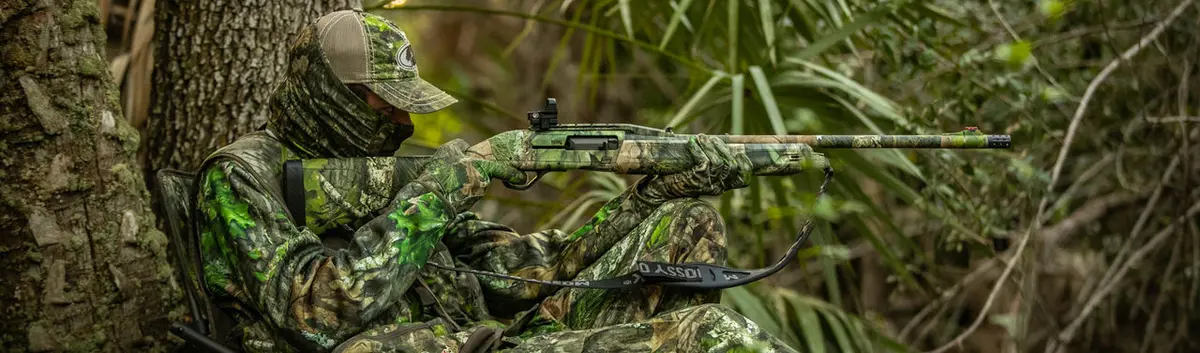
4 Great Turkey Guns from Winchester Repeating Arms
Published April 20, by Jace Bauserman
I didn’t give in to the sub-gauge turkey craze. Though I’ve jellied heads with 28-gauge and .410 bore shotguns, and had a blast doing it, I’m a 12-gauge guy, and that will never change. Occasionally though, I’ll tote a 20-gauge and have excellent success with it. However, every one of my sub-gauge turkey hunts had one thing in common. I was shooting Tungsten Super Shot (TSS) ammunition.
What is TSS?
Tungsten Super Shot (TSS) is a game-changing shotgun ammo specifically engineered for turkey hunting. It’s made from a high-density (18g/cc) tungsten alloy, making it incredibly effective in the field. The secret lies in its density — TSS is about 60 percent denser than lead. This allows hunters to use smaller shot sizes while still achieving impressive lethality, meaning more pellets in a tighter pattern and the ability to harvest birds at longer distances.
Due to its shot density and ability to penetrate, TSS lets hunters drop from a 12-gauge shotgun to sub-gauge models for larger birds like turkeys and still achieve success, even at distances up to 60 yards. Sub-gauge shotguns tend to be lighter and produce less recoil, making the idea of slinging a sub-gauge over the shoulder ultra-attractive. Plus, there’s the cool factor. Many hunters want to shoot turkeys with sub-gauge shotguns with TSS loads because it makes the feat of the harvest sound more impressive. Then, there are those who have harvested so many birds with a 12-gauge that they're just looking for a new challenge.
TSS is Different
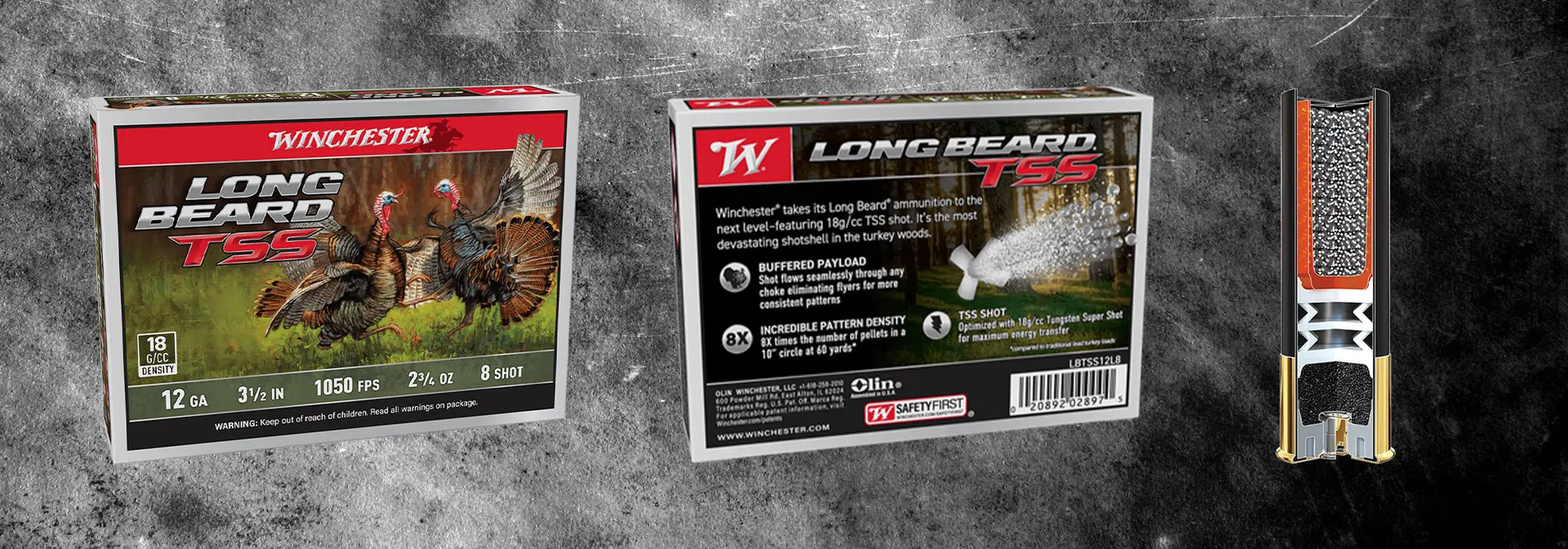
I’ve tested shotguns, chokes, and ammo for 20 years and found that nothing bests the performance of TSS. In 2018, I shot a 3-inch, 2-ounce payload of #9 TSS at a turkey target with a factory Invector-Plus full choke from 80 yards. My jaw dropped. There were more than enough pellets in the head/neck area of the target to kill a bird, and most of the pellets were buried deep in 1/2-inch-thick plywood.
Until 2018, my turkey go-to was Winchester’s 12-gauge 3-inch, 1-3/4-ounce, #6 Long Beard XR. It killed birds extremely well out to 40 yards and patterned decently to 50. That hasn’t changed. I still slay birds with Long Beard XR and other lead loads.
The TSS loads I’ve tested, though, including Winchester’s new-for-2026 Long Beard Tungsten, trumps lead. That’s a fact. I can send more small pellets with increased lethality and put more pellets on target with TSS than I can with lead.
The TSS Conundrum
Tungsten Super Shot is attractive because tungsten’s very high density can deliver superior downrange energy and tighter patterns. However, producing it at a commercial scale is tough for several reasons: First, raw tungsten is expensive, and supply is constrained. Tungsten concentrates come mainly from a few countries, driving volatility in material costs that makes affordable shotshell production difficult. Import tariffs are also high. Second, tungsten is extremely hard and brittle, so traditional lead-shot manufacturing methods (casting or simple cold-forming) don’t work. Producing uniform, spherical tungsten pellets requires advanced powder metallurgy, high‑pressure compaction, sintering, or metal‑matrix composites — processes that demand specialized equipment, long cycle times, and tight process control.
Those processes also generate high tooling wear and maintenance costs. Third, coatings or alloying are often needed to prevent oxidation and to ensure proper barrel behavior, adding complexity and testing requirements. Quality control is critical, as marginal differences in pellet density, sphericity, or hardness can ruin performance or damage barrels. Finally, market size remains limited compared with lead, so manufacturers struggle to amortize tooling and R&D costs. Regulatory pressure to replace lead creates demand, but until materials, supply chains, and production methods scale and become cheaper, wide adoption of Tungsten Super Shot will remain economically and technically challenging.
What is the TSS Answer?
We’re not telling you not to shoot TSS. We love it. What we are telling you is that sub-gauge craze or not, the 12-gauge is still king, and lead still kills. I spent last week at a South Dakota turkey camp with 12 hardcore turkey hunters, including one world-champion caller and several others who make their living hunting wild turkeys. Guess how many of them shot a sub-gauge? Zero!
Why?
Turkeys haunt them. They want to leave nothing to chance. They know a 3-inch, 2-ounce TSS 12-gauge load has more pellets, and more matters. Close or far, these hunters want to boost their odds of busting a tom’s dome, and no gauge is better than the 12 for that.
Because the 12-gauge shotgun is the most popular gauge, kingpin shotshell makers will produce TSS in that gauge more than any other, especially as materials get tight. Keep that in mind.
Lead Still Makes Them Dead
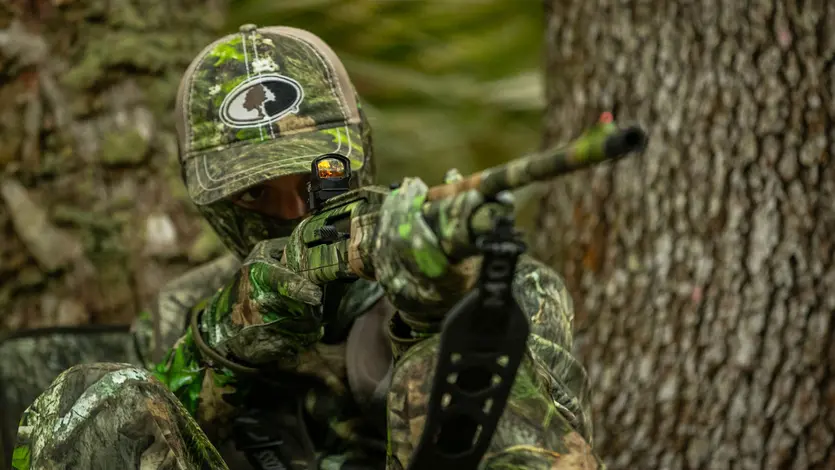
I feel like TSS has made, at least in the minds of some hunters, obsolete. This shouldn’t be. TSS has been around for less than a decade. How long have hunters been killing gobblers with lead? Over a century.
The object of turkey hunting is to get birds close. Though I know I can kill a longbeard at 70-plus yards with TSS, I’d never do it. That’s not why I hunt turkeys. I hunt turkeys because I want to put a hard-gobbling bird in my lap. Lead still makes them dead. It’s hard to beat a 12-gauge, 3-inch, 1-3/4-ounce payload of #5 or #6 lead.
Many hunters appreciate the familiar ballistic behavior of lead loads in their existing shotguns and chokes, avoiding the need to re-tune patterns. Lead #5 and #6 loads produce tight, consistent patterns with factory and custom chokes.
Another clear advantage: lead shells are widely stocked at local stores and online retailers, making them easy to obtain. Cost remains a major factor — lead ammo is significantly less expensive than specialty TSS, so hunters can afford to practice and carry sufficient shells without breaking the budget. Lead offers a balanced mix of performance, affordability, and accessibility, making it a practical, effective choice for turkey season. Many seasoned hunters still trust them for dependable, consistent field results.
Why The 12-Gauge is Still King
A 12-gauge delivers more pellets on target, more energy, and more patterning/options at turkey ranges than smaller gauges, making it more forgiving and effective.
Key reasons:
- Pellet count/pattern density: 12-gauge shells can carry a larger payload (more pellets) at turkey shot sizes (e.g., 4, 5, 6). More pellets hitting the head/neck increase instant lethality and margin for error.
- Energy and penetration: Greater mass and velocity mean better downrange energy and penetration through feathers/skin to vital tissue at typical turkey ranges (20–50 yds).
- Flexible load selection: Wide commercial selection of turkey-specific loads. Sub‑gauges have fewer specialized turkey loads.
- Chokes and patterning: 12‑gauge choke options and forcing cones are optimized to achieve dense, tight patterns.
- Effective range: At common turkey distances, a 12-gauge will retain pattern and energy better; sub‑gauges often require heavier shot or reduced range to match performance.
- Availability and cost: Ammunition, chokes, and accessories for turkeys are more widely available and often cheaper in 12‑gauge.
Bottom line: for most turkey hunters, the 12‑gauge gives the best combination of pellet numbers on target, energy, patterning flexibility, and ammunition choice, making it the most effective and forgiving option.
Three Excellent 12-Gauge Turkey Options
Winchester SXP Turkey
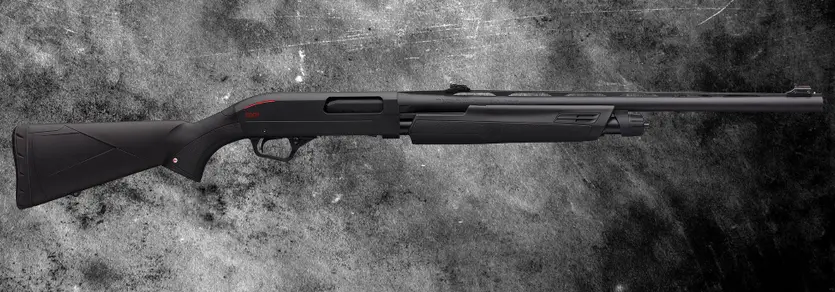
Winchester makes several turkey-specific shotguns, the SXP Long Beard and SX4 Cantilever Turkey, to name a few. However, if you want an excellent, economical, pump-action 12-gauge that will consistently bust beaks, the SXP Turkey is an excellent choice.
- Proven pump reliability: Simple, rugged pump action cycles all loads (including heavy 3.5" magnums) with minimal fuss — very forgiving in dirty/field conditions.
- Short, fast pump stroke: Allows quick follow-up shots; important on a turkey that moves at the last second.
- 3.5" chambering: Accepts full-power turkey shells for maximum pellet count, energy, and pattern density.
- Optimized barrel & chokes: Factory turkey barrels and interchangeable choke tubes tuned for tight, consistent patterns at typical turkey ranges.
- Low cost/high value: More affordable than many autoloaders while offering comparable turkey-specific performance and durability.
- Durable, field-ready finishes: Camouflage or matte coatings resist wear and glare and are designed for rough use.
- Good ergonomics and sighting: Vent rib, high-visibility bead or fiber-optic sight, and a stock geometry suited for standing or blind shots.
- Lightweight and balanced: Easier to carry all day and faster to point at a calling bird.
- Easy maintenance: Simple disassembly and cleaning in the field or at home.
Winchester SX4 Cantilever Turkey
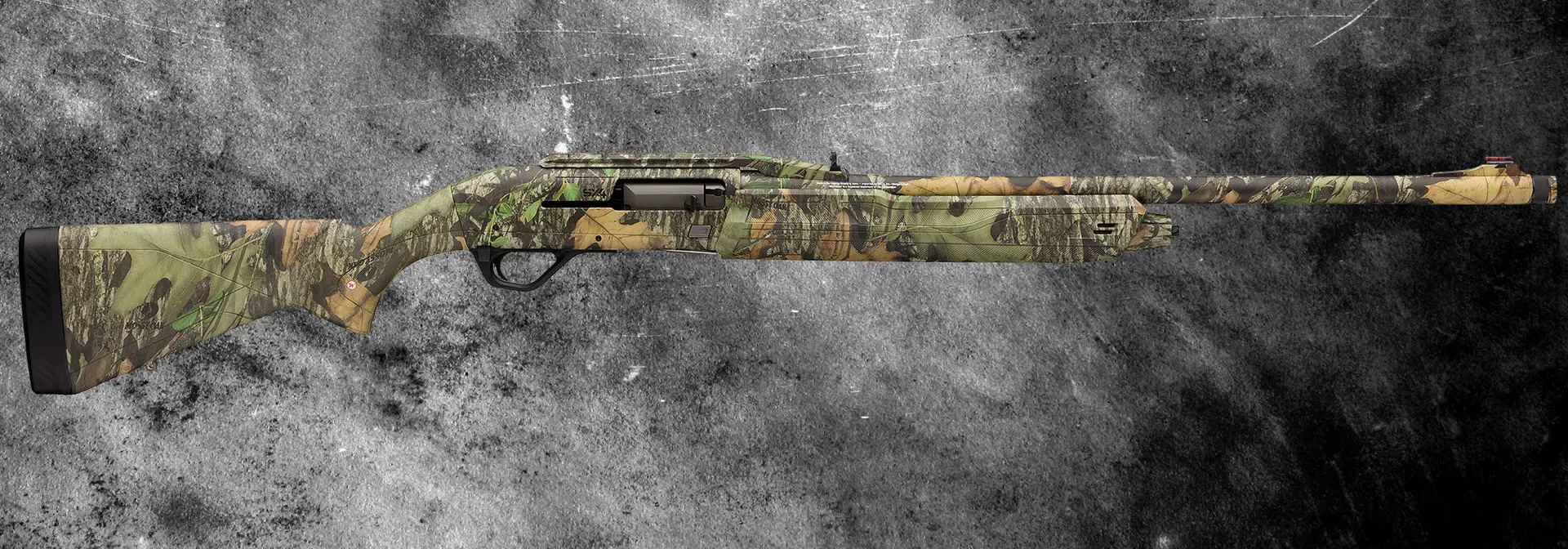
A purpose-built turkey slayer cloaked in Mossy Oak Obsession camo with adjustable rifle-style sights and a TRUGLO fiber-optic front sight, the Cantilever Turkey is out-of-the-box ready. The cantilever rail makes it simple to attach a standard or red-dot scope, and the shotgun uses the bulletproof Active Valve System.
- Cantilever optics rail: Raises and offsets optics for fast, comfortable cheek weld with a full shotgun sight picture and room for a red dot or scope over the rib.
- Active Valve Gas System: Semi‑auto operation that softens recoil and cycles reliably with heavy turkey loads for fast follow‑up shots and less shooter fatigue.
- 3-1/2" chamber and magnum‑load compatibility: Handles heavy turkey loads for dense patterns and long-range knockdown power.
- Patterning options and choke compatibility accepts extended turkey/full chokes for tight, consistent patterns.
- Balance and handling: tuned weight and stock geometry for quick target acquisition on fast, flying birds.
- Hunting finishes and ergonomics: Full coverage camo, good sling/strap mounting points, oversize, controls, and a comfortable recoil pad.
Together, those features make it fast on target, comfortable to shoot, and easy to mount optics —ideal for modern turkey hunting.
Winchester SXP Universal Hunter
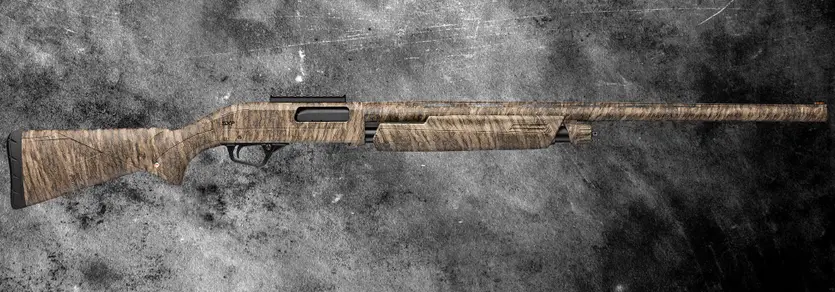
Another turkey slaying 12-gauge that doesn’t break the bank, Winchester’s SXP Universal Hunter is a multi-purpose shotgun with an aluminum alloy receiver and composite stock. We like the Mossy Oak DNA camo finish.
- Pump-action reliability: Simple, rugged action that cycles virtually any turkey load and won’t be fussy with dirty/wet conditions.
- Inertia-assisted Speed Pump action: Smooth pump stroke for quick follow-up shots and fast target reacquisition.
- 3-1/2" chamber: Handles heavy turkey loads for dense, effective patterns.
- Choke compatibility: Includes an Extra-Full Invector-Plus turkey choke for tight patterns at typical turkey ranges. Also comes with Full, Mod, and Improved Cylinder tubes for multi-season versatility.
- Tactical/vent rib and sighting: Ventilated rib and a clear sight plane (bead or fiber-optic options) make quick target acquisition easier. Includes a removable Picatinny rail for mounting a red-dot sight.
- Durable camo finish and synthetic stock: Mossy Oak DNA camo for concealment plus weather-resistant materials for field use.
- Good balance and handling: Designed for pointing and mounting quickly from sitting or standing turkey setups.
- Value and simplicity: Typically, more affordable and easier to maintain than many semi-autos, while still offering the performance hunters need.
These traits make these Winchester options dependable, easy-to-shoot, and concealment-friendly turkey guns. And, if you like the feature sets, all these guns are also available in 20-gauge models.
The Bottom Line
The world of TSS is changing, and there’s no immediate answer in sight. Winchester’s new Long Beard Tungsten uses 17g/cc, not 18g/cc.
Why?
The short answer is manufacturability. Most commercial tungsten shot for shotshells is a sintered tungsten alloy or tungsten-polymer composite. Those processes reliably produce densities around 16.5–17.5 g/cc. Reaching a true 18 g/cc requires different alloying or processing that’s harder, more expensive, or less repeatable.
Still, lead kills. Lead is cheaper, dependable, and an excellent option for turkey hunters wanting to call birds within 50 yards.